
Don't take my word for it, even Amy Edmondson in her book, Teaming: How organizations learn, innovate, and compete in the knowledge economy, references the need for a learning organization (LO) stating, "most leaders and managers recognize that organizations that don’t learn are left behind their more innovate and adaptive competitors. In this dynamic environment, successful organizations need to be managed as complex adaptive systems rather than as intricate controlled machines (p. 31)". Peter Senge echos similar truths in his book, The Fifth Discipline stating, “The organizations that will truly excel in the future will be the organizations that discover how to tap people’s commitment and capacity to learn at all levels in an organization (p.17).” Furthermore, Bob Garrett, referencing the works of Reg Revans, gives us Action Learning and the change equation, "L ≥ EC: If your Learning isn’t equal (or greater) than the rate at which your environment is changing… you will soon be History" (Pedler, 2011. p.24). Revans' learning equations holds that L=P+Q where learning is a combination of P (Programmed knowledge, or the content of traditional instruction), and Q (Questioning insight, derived from fresh questions and critical reflection) (p.29).
Learning Organizations (LO) are today's "secret weapons" to a competitive market place seeking not only innovation but how to attract, recruit, and keep talented a talent work force. 'Secret weapon' because most companies either are not aware of the Learning Organization concept or will not take the time time to invest into that such a program.
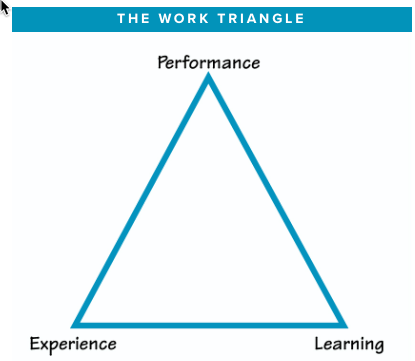
According to Timothy Gallwey's, "The Inner Game of Work: Building Capability in the Workplace," his "Work Triangle" model references three primary interrelated user constructs: Learning, Experience, and Performance. These three constructs are emergent in nature and highly influence each other. That is, if user's Performance is lacking, one needs to review if a Learning and/or Experience deficit is the culprit. If "Performance" is high, both one's "Learning" and "Experiences" are being met. It is vital that organizations invest in an effective learning program not only to perpetuate workforce high performance, but to invest into their most precious commodity, their own People.
References
Edmondson, A. C. (2012). Teaming: How organizations learn, innovate, and compete in the knowledge economy. John Wiley & Sons
Gallwey, T. (1997). The inner game of work: building capability in the workplace. The Systems Thinker, 8(6), 1-5.
Pedler, M. (Ed.). (2011). Action learning in practice. Gower Publishing, Ltd..
Senge, P. M. (2006). The fifth discipline: The art and practice of the learning organization. Currency
