
According to Reg Revan's, organizations must "learn at a rate equal to or faster than the rate of change in their environment" which kicks off the idea that we have to modify our learning or unlearn current artifacts to upgrade our meaning-making.
The Learning vs Unlearning Organization
When we need to learn or relearn a new concept or construct, you need to re-review the content for better comprehension or clarification which can be inline with term "Unlearning".
When I think of scaling Unlearning from the individual to the organization, I always think of Peter Senge's reference to context perception that: "people do not perceive reality, rather, they perceive reality they know how to perceive (Humberto R. Maturana)" which requires one to appreciate the idea that we may need to step back and apply a more Gestalt and/or system thinking approach to better understand phenomenon. That is, from the organizational perspective, to unlearn a concept, we may have to understand its contextual perception and utilize a tool called, Mental Models.
 admin
admin
Understanding "Context Perception"
Some of initial tools I use to increase my understanding of context perception is Argyris' "Mental Models" and his "Ladder of Inference" which describes how we synthesize information and knowledge. That is, how we think can be shortsighted, resulting in actions and decisions that are shortsighted.
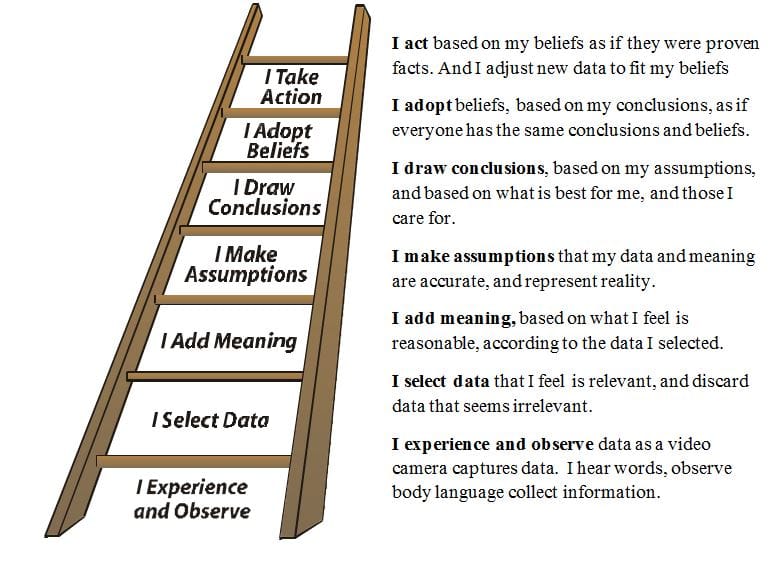
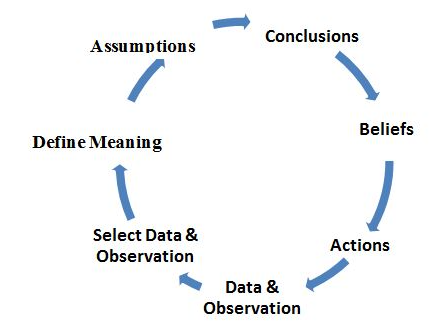
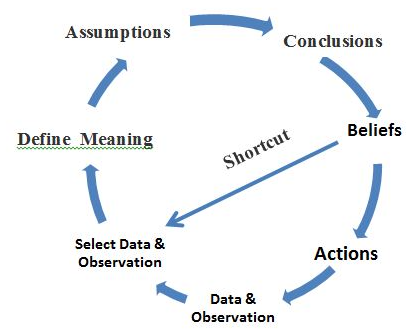
Since we "do not perceive reality, rather, perceive reality we know how to perceive," perhaps we need to better intake our experiences and information to better translate it into comprehensive knowledge which can influence effective and more accurate actions and decisions. Thus, if you follow all the steps of the "Ladder of Inference," you should have a greater understanding of the phenomena you are trying to grasp, which should reduce the effects of context perception.
Rather, if one of the steps is inadvertently skipped or takes a shortcut, your understandings will probably decrease.
Let me know your thoughts and challenges on this topic.
Best,
~Dr. Petersen
Argyris, C., Putnam, R., Smith D.M. 1985. Action Science: Concepts, Methods, and Skills for Research and Intervention. San Francisco: Jossey-Bass.
Doyle, C. (1892) The Adventures of Sherlock Holmes. Retrieved from http://www.pagebypagebooks.com/Arthur_Conan_Doyle/The_Adventures_of_Sherlock_Holmes/ADVENTURE_I_A_SCANDAL_IN_BOHEMIA_p3.html
Revans, R. W. (1980). Action learning: New techniques for management. London: Blond & Briggs.
Senge, P. (2006). The fifth discipline: The art and practice of the learning organization. New
York, NY: Doubleday.
